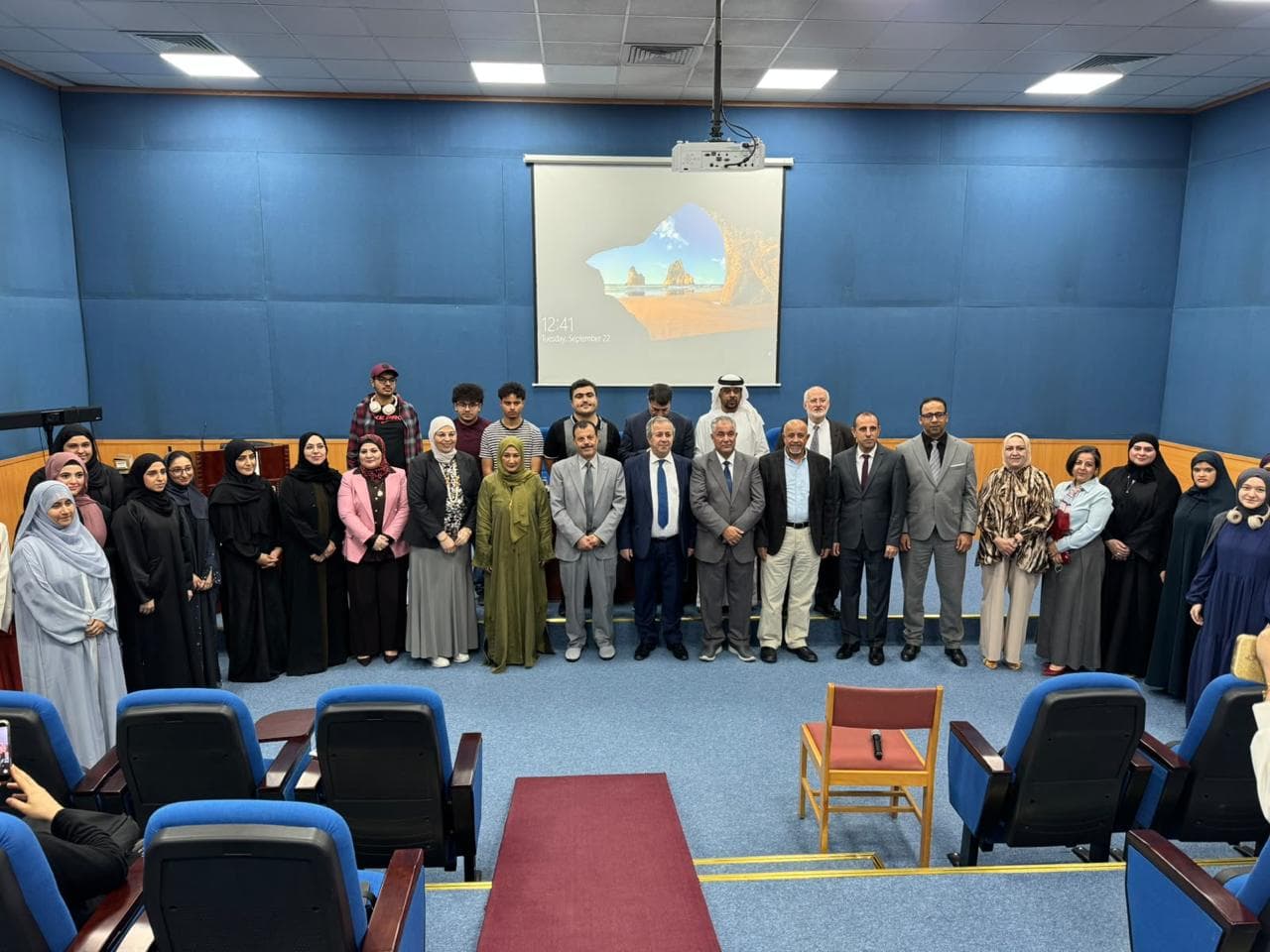
Orientation and Guidance Meeting for New Students 2026/2027
As part of the University of Sharjah's commitment, through its College of Arts, Humanities and Social Sciences, to preparing its students, particularly new students, for active and informed engagement in University life and familiarizing them with the academic environment, services, and opportunities available at the University, an orientation meeting for students of the College of Arts, Humanities and Social Sciences was held on Tuesday, September 22, 2026.
The meeting served as both an introductory and guidance platform aimed at helping students transition from their initial reception into University life to a deeper awareness of their academic, behavioral, and institutional responsibilities. Through a series of presentations, participants explored topics including the nature of the student-faculty relationship, the importance of academic commitment, communication channels and complaint procedures, the effective use of technology and scientific research, awareness of academic misconduct and plagiarism, and the various opportunities, activities, and services offered by the University.
The event reflected a comprehensive vision of University life, emphasizing that the student experience extends beyond attending lectures and passing courses. Rather, University education is viewed as a crucial stage in developing scholarly and personal character, fostering responsibility, and shaping the future.
Objectives
The orientation meeting sought to achieve several academic and advisory objectives, including:
• Introducing students to the University environment, including its regulations, policies, resources, and services.
• Clarifying the nature of a healthy academic relationship between students and faculty members and emphasizing the importance of building it on respect and trust.
• Promoting a culture of attendance, academic discipline, and personal responsibility.
• Familiarizing students with appropriate channels of communication with academic advisors, department chairs, and University leadership.
• Encouraging students to employ technology and artificial intelligence positively and responsibly in learning and scientific research.
• Raising awareness of academic misconduct, particularly cheating, and explaining its consequences for students, the College, and the University.
• Encouraging students to benefit from office hours, seminars, conferences, and academic events.
• Introducing students to University facilities, associations, clubs, councils, and the opportunities they provide for personal development.
• Reinforcing the concepts of institutional belonging and shared responsibility between students and the University.
• Helping students view their University years as an opportunity to shape their future rather than merely obtain a degree.
Session Highlights and Faculty Contributions
Professor Mamoun Abdulkarim: Building Meaningful Academic Relationships
His Excellency Professor Mamoun Abdulkarim, dean of the College of Arts, Humanities and Social Sciences, delivered several important guidelines addressing key aspects of University life, focusing particularly on the relationship that should exist between faculty members and students.
He emphasized that this relationship should be built upon sound academic and human values, likening it to the relationship between a father and his child, highlighting the importance of a learning environment characterized by respect, trust, guidance, and academic support.
He noted that such a healthy relationship is one of the foundations of a positive academic environment within the College of Arts, Humanities and Social Sciences. He urged students to absorb beneficial advice, learn from guidance offered by faculty, and approach their studies and University life with seriousness and responsibility rather than viewing the University merely as a place to attend classes.
Professor Abdulkarim also stressed the importance of punctuality and regular attendance, explaining that membership in a University community entails institutional commitment and respect for University regulations, policies, and values.
Academic Complaints: A Right Accompanied by Responsibility
Professor Abdulkarim further discussed the subject of academic and administrative complaints, emphasizing that a student's right to raise concerns or complaints must be accompanied by awareness and responsibility.
According to this perspective, a complaint should not be an impulsive expression or a product of frustration; rather, it should be a responsible action based on a genuine understanding of the issue and appreciation of its implications while respecting established academic and administrative procedures.
Accordingly, inquiries and concerns should begin with the channels closest to the student, such as the academic advisor, followed by the department chair, and, when necessary, the dean. This approach preserves institutional respect and ensures that issues are addressed through the appropriate mechanisms.
The dean concluded by encouraging students to remain future-oriented and to use their University years as a period of learning, personal growth, self-development, and continuous pursuit of excellence.
Dr. Sami Al-Qatawneh: Do Not Search for Your Future, Help Create It
The session continued with a presentation by Dr. Sami Al-Qatawneh, chair of the Academic Advising Committee, who addressed several questions commonly asked by new students at the beginning of their University journey: What will University life be like? What will my future look like? How can I succeed?
His key message was that students should not merely seek ready-made answers to these questions but should actively participate in creating those answers themselves.
He stressed that the University seeks not only students who can pass courses but also students who are productive, passionate about learning, capable of utilizing technology, engaged in scientific research, and committed to continuous skill development.
Dr. Al-Qatawneh discussed a range of challenges that both students and faculty members may encounter during the educational process, emphasizing that overcoming these challenges requires cooperation, awareness, and commitment from both parties.
He further underscored the importance of punctual attendance, adherence to University regulations, engagement with academic communications and guidance, and taking advantage of office hours as opportunities for direct interaction with faculty members, asking questions, clarifying concerns, and building stronger academic relationships.
He also encouraged students to attend and participate in seminars, conferences, and academic events, noting that simply being present at such activities contributes to personal development and broadens one's knowledge and experience.
Dr. Alaa Al-Taie: Academic Integrity as the Foundation of Success
Dr. Alaa Al-Taie, chair of the College Behavioral Conduct Committee, addressed one of the most important aspects of University life: academic integrity and cheating.
She explained that cheating is inherently a negative practice, both in form and substance, even though some students may attempt to justify it based on personal circumstances or perceived benefits. Such justifications do not alter its nature as a violation of academic standards.
Dr. Al-Taie emphasized that the University treats cheating as a serious offense affecting not only the student's academic standing but also the reputation of the educational environment and institution.
She noted that detecting academic misconduct is not limited to obvious cases but includes various methods used during examinations, such as unauthorized notes, electronic devices, earpieces, and other prohibited tools. She also clarified the distinction between suspicion of misconduct and the formal process of proving a violation according to University procedures.
Students were encouraged to approach their studies with honesty and integrity, recognizing that they represent not only themselves but also their College and University. Consequently, any negative conduct may affect both the individual and the institution to which they belong.
In the same context, she highlighted the importance of viewing technology and modern software applications positively, particularly research and artificial intelligence tools, and using them to enhance learning and scientific research rather than employing them in ways that violate academic regulations and values.
Dr. Salama Al-Rahoumi: University Years Are a Once-in-a-Lifetime Opportunity
The session concluded with a discussion led by Dr. Salama Al-Rahoumi, dean of Student Affairs for Female Students, who reflected on the four-year University journey and emphasized that these years represent a unique and significant stage in a student's life that should be invested wisely and positively.
She encouraged students not to limit their University experience solely to academics but to benefit from the many opportunities available for personal growth, skill development, and exploration of interests.
Dr. Al-Rahoumi highlighted the facilities, services, and supportive environments available at the University, including restaurants, cafés, study spaces, University complexes, student associations, the University art studio, the student council, clubs, and various extracurricular activities.
She explained that these resources are not merely recreational facilities or supplementary services but can play a significant role in shaping students’ personalities, developing communication, teamwork, leadership, and initiative, and encouraging broader participation in University life.
Recommendations and Key Takeaways
The meeting concluded with several important recommendations intended to guide students throughout their university years:
- Approach university life with seriousness and responsibility, rather than limiting it to attending classes and earning grades.
- Adhere to schedules, attendance requirements, and academic regulations as essential components of university responsibility.
- Build positive relationships with faculty members based on respect, trust, and constructive academic dialogue.
- Take advantage of academic advisors and office hours and do not hesitate to ask questions or seek guidance.
- Follow academic and administrative procedures when raising concerns or complaints and ensure that complaints are submitted responsibly and thoughtfully.
- Maintain academic integrity and avoid cheating in all its forms.
- Utilize technology and artificial intelligence responsibly in learning and research, transforming modern tools into vehicles for productivity and knowledge creation.
- Attend and participate in academic, scientific, and cultural events that align with personal interests.
- Benefit from student associations, clubs, councils, and activities to develop skills and leadership qualities.
- Strengthen institutional belonging through positive behavior and adherence to university values and regulations.
- View university years as a period for shaping the future rather than merely obtaining a degree.
Conclusion
The orientation meeting for students of the College of Arts, Humanities and Social Sciences at the University of Sharjah provided a comprehensive academic and advisory platform that combined an introduction to University life with clarification of student responsibilities. It also delivered educational, academic, and behavioral messages designed to help students build a more informed, productive, and meaningful University experience.
The event reflected the College of Arts, Humanities and Social Sciences’ commitment to preparing students for successful integration into University life through a balanced approach that combines academic achievement, institutional commitment, academic integrity, student engagement, and the effective use of technology and scientific research.
Perhaps the most significant message conveyed throughout the event was that the University is not merely a place to earn a degree. Rather, it is an environment for shaping knowledge, character, and the future, while fostering personal growth. Student success is measured not only by achievements in the classroom but also by the ability to seize opportunities, assume responsibility, respect the institution, contribute to its academic community, and transform the University years into a genuine journey of learning, growth, and future-building.
Activity Highlights