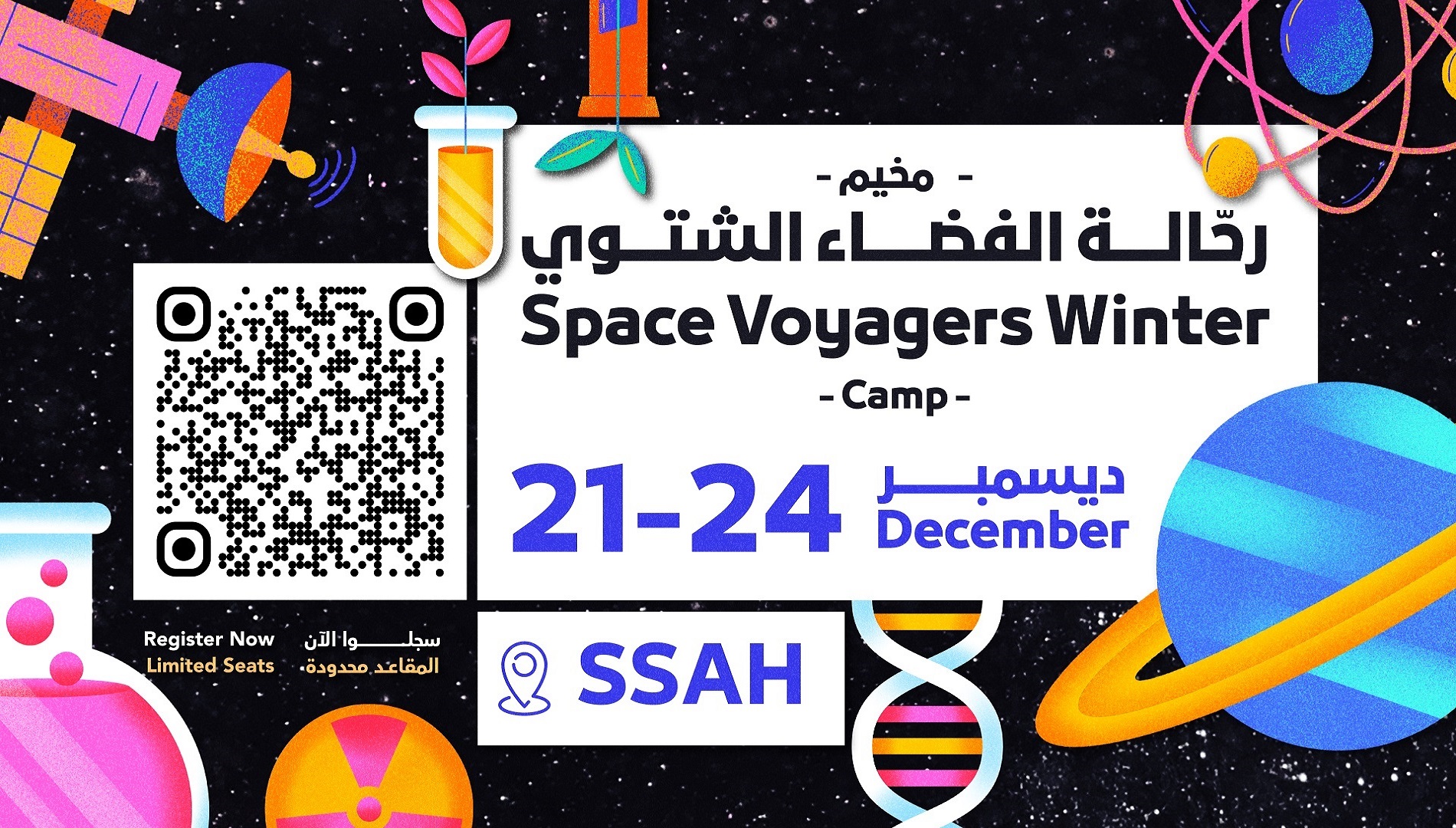
Dates: 21 - 24 December 2026
Location: Sharjah Space and Astronomy Hub (SSAH)
To Register, CLICK HERE
|
Day 1
Sundials – Reading Time from the Shadow
|
| Time |
Session |
Activity Details |
Duration |
|
10:00 AM – 11:15 AM
|
Session 1: What is Time & How Sundials Work
|
- Introduction to ancient timekeeping devices (hourglass, stopwatch).
- Explore apparent solar motion vs. Earth's rotation and the 15°/hour rule.
- Learn how sundials work and why the gnomon must point to the North Celestial Pole.
|
1 hr 15 mins
|
|
11:15 AM – 11:30 AM
|
Break
|
Break
|
15 mins
|
|
11:30 AM – 1:00 PM
|
Session 2: Sundial Construction & Calibration
|
- Hands-on activity: cut, fold, assemble, and attach the gnomon to build a personal sundial.
- Outdoor testing: use a compass to find true north, orient the sundial, and mark the shadow.
- Compare solar time with clock time, followed by workshop reflection and Q&A.
|
1 hr 30 mins
|
|
Day 2
Mission Control: Dragon Docking Challenge
|
| Time |
Session |
Activity Details |
Duration |
| 10:00 AM – 11:00 AM |
Session 1: Orbital Mechanics & Simulator Basics |
- Introduction to the Dragon spacecraft and ISS.
- Learn principles of orbital motion, relative velocity, and spacecraft orientation.
- Familiarization with the simulator's flight indicators and controls.
|
1 hr |
| 11:00 AM – 11:30 AM |
Break |
Break |
30 mins |
| 11:30 AM – 1:00 PM |
Session 2: Dragon Docking Challenge |
- Hands-on practice using the online docking simulator.
- Apply gradual corrections to reduce positional and rotational errors.
- Complete a final docking attempt and evaluate performance based on precision.
|
1 hr 30 mins |
|
Day 3
CubeSat Engineering: From Subsystems to Hands-On Application
|
| Time |
Session |
Activity Details |
Duration |
| 10:00 AM – 11:00 AM |
Session 1: Introduction to CubeSats |
- Introduction to CubeSats, their advantages, and applications.
- Stages of CubeSat development, launch, and operation in orbit.
- Overview of Sharjah-Sat-1 and Sharjah-Sat-2 projects.
- Interactive discussion on CubeSat applications.
|
1 hr |
| 11:00 AM – 11:30 AM |
Break |
Break |
30 mins |
| 11:30 AM – 1:00 PM |
Session 2: Hands-On CubeSat and Subsystems Simulation Using Arduino |
- Introduction to the satellite structure, electrical power system, onboard computer, communications, attitude control, and scientific payload.
- Hands-on demonstration of component connections, integration, and operation.
- Introduction to Arduino, solar cells, and temperature sensing.
- Connecting the solar cell and temperature sensor to Arduino.
- Testing the effects of light and temperature and discussing the results.
|
1 hr 30 mins |
|
Day 4
The Search for Life in the Cosmos
|
| Time |
Session |
Activity Details |
Duration |
| 10:00 AM – 11:30 AM |
Session 1: What Makes a Planet Habitable? |
- Introduction to astrobiology and the search for life beyond Earth.
- Explore the "Goldilocks Zone" and conditions needed for life.
- Interactive discussion: Compare Earth with Mars, Venus, and selected exoplanets.
- Group challenge: Rank planets according to their potential habitability based on provided clues.
|
1 hr 30 mins |
| 11:30 AM – 11:45 AM |
Break |
Refreshment break |
15 mins |
| 11:45 AM – 1:00 PM |
Session 2: Alien Biology Lab |
- Investigate how planetary environments influence living organisms.
- Activity: Design an alien species adapted to a unique planetary environment.
- Present and explain how environmental factors shaped the alien's biology and appearance.
- Workshop reflection and discussion on real scientific methods used to search for life.
|
1 hr 15 mins |
| 1:00 PM – 2:00 PM |
Winter Camp Conclusion |
Planetarium show and certificate ceremony |
1 hr |

