Global
University of Sharjah Launches Global Leadership Program for Age-Friendly Environments
“Connect, Inspire, Support” brings together international experts and local leaders to shape more inclusive communities for older adults.
The University of Sharjah inaugurated a specialized leadership training program, “Connect, Inspire, Support: Leadership Course on Age-Friendly Environments,” bringing together local and international experts to examine how cities and communities can better support older adults.
The two-day program, held on September 29 and 30, is organized by the University’s Center of Excellence in Healthy Aging in collaboration with the World Health Organization’s Global Network for Age-Friendly Cities and Communities and the Sharjah Age-Friendly Office of the Sharjah Social Services Department. International academics and experts accredited by the World Health Organization shall participate in the program.
The program reflects the vision and directives of His Highness Sheikh Dr. Sultan bin Ahmed bin Sultan Al Qasimi, Deputy Ruler of Sharjah, and President of the University of Sharjah, to strengthen integration between academic institutions and government entities in service of the community. It also forms part of the University’s continuing effort to obtain international accreditation for its Center of Excellence in Healthy Aging as a WHO Collaborating Center, in a step intended to strengthen Sharjah’s international standing in quality of life and care for older adults while reflecting the University’s human and community-centered role.
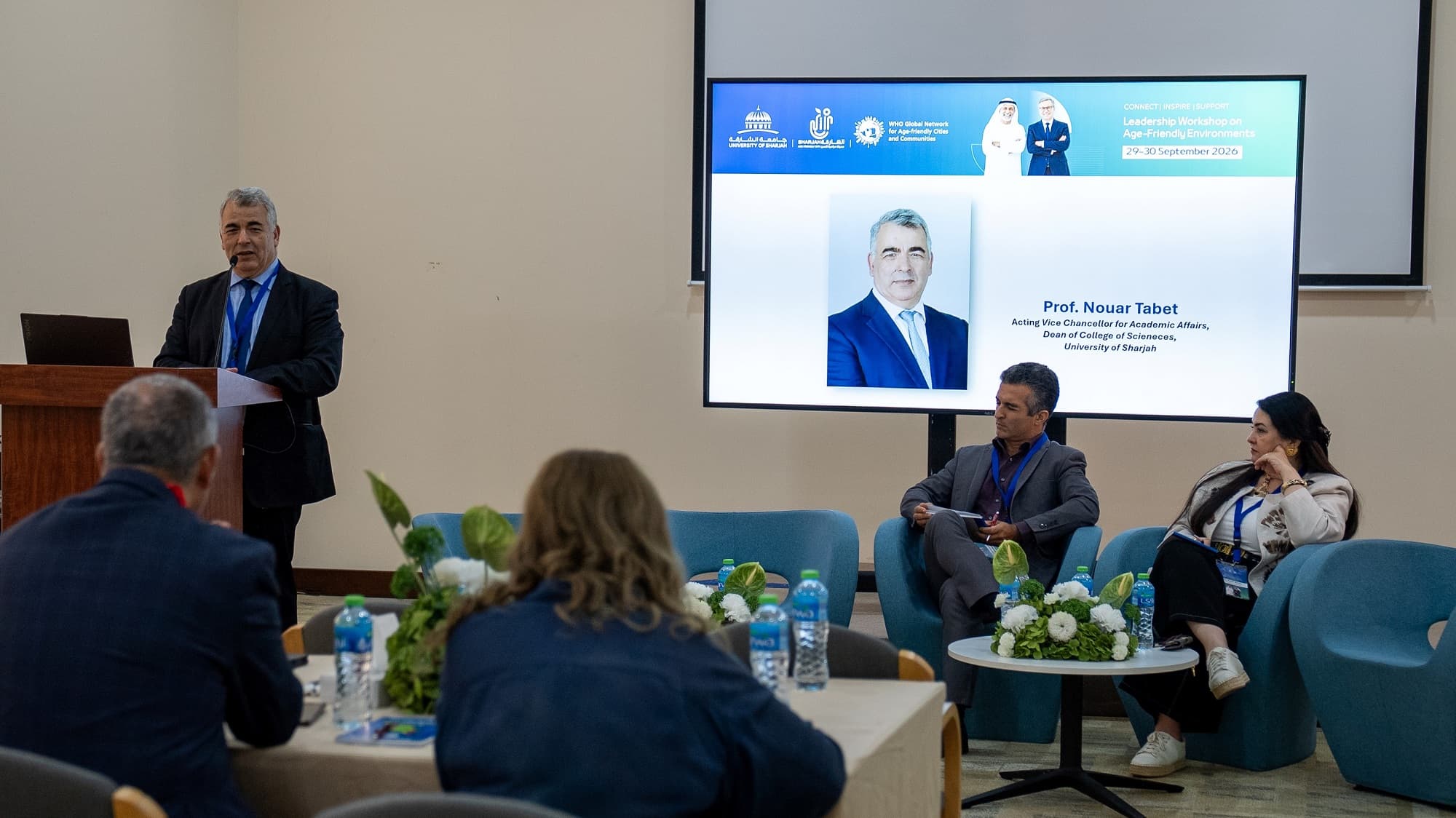
In opening remarks, Prof. Nouar Tabet, Acting Vice Chancellor for Academic Affairs, said that population aging has become one of the world’s most pressing public-health priorities and challenges. In response, the University is drawing on its academic resources and multidisciplinary research expertise to contribute to evidence-based policymaking and support community innovation. He added that the pursuit of WHO accreditation for the Center of Excellence is a considered strategic step that will strengthen the University’s institutional and research standing, increase its global competitiveness and expand its sustainable social impact. Dr. Amina Almarzooqi, Vice Chancellor for Student Affairs, said that Sharjah’s journey since becoming the first Arab city to join the WHO’s Global Network for Age-Friendly Cities and Communities in September 2016 has been more than a conventional membership. It has represented a sustained commitment to development and comprehensive partnerships across the areas of age-friendly environments.
She also emphasized that older adults are active partners whose experiences should inform the design and evaluation of initiatives. Sharjah’s vision, she said, is to bring vitality, dignity and meaningful participation to later life. She described the University of Sharjah as an essential partner in translating research into practice, generating evidence and developing innovations that help ensure a sustainable and supportive environment. “Age-friendly environments are now an immediate responsibility,” she said, noting that an age-friendly city is, in essence, a better place for people of every age.
Dr. Tamer Shousha, Director of the University’s Center of Excellence in Healthy Aging, said the center is committed to sharing successful experiences and connecting theoretical frameworks with field practice to help ensure an integrated and safe environment that meets the needs of older adults and improves the quality of services available to them.
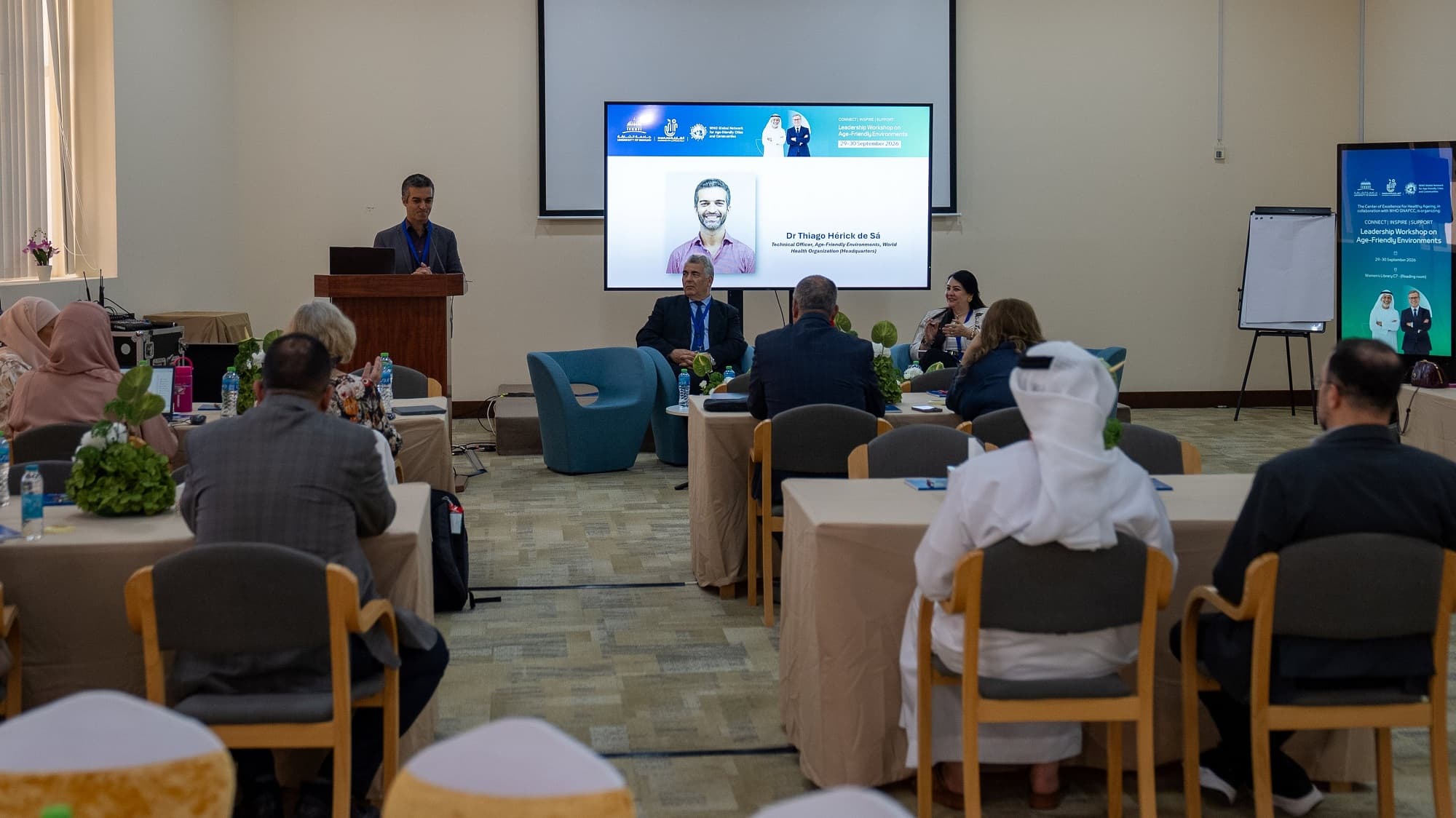
The opening session of the first day included talks by Dr. Thiago Herick de Sá, WHO Technical Officer for Age-Friendly Environments at the organization’s headquarters in Geneva; Dr. Samar Al Feki, Regional Adviser for Social Determinants of Health and Community Initiatives; and Asma Al Khudari, Director of Health Services and the Sharjah Age-Friendly Program at the Sharjah Social Services Department. The session was followed by an interactive workshop and group working sessions on combating ageism.
The first day continued with specialized scientific sessions. Nur Hasnah Akhir, an expert from Malaysia, presented experiences in local action and service planning in age-friendly cities. New Zealand expert Diane Turner, joined by Dr. Al Feki, discussed governance mechanisms, scaling initiatives, connecting local policy with national policy and coordinating financing. In addition, a joint discussion with the WHO delegation examined a whole-of-government and whole-of-society approach to creating supportive environments. Dr. Shousha concluded the first day with a session on drawing lessons from the discussions and linking policy with real-world practice.
The program’s second day includes field visits that will allow participants to observe age-friendly initiatives and practical applications across Sharjah and to engage with practitioners and beneficiaries. The agenda will continue with an extended working session on the current map of scientific evidence and on translating research and innovation into practical action. The program will conclude with a practical workshop for developing implementation plans suited to participants’ local environments, followed by closing remarks from Dr. Amina Almarzooqi reviewing the program’s outcomes and final recommendations.
Share
Quick Links
Activity Highlights