Global
University of Sharjah Explores Knowledge Migration Between East and West in Ancient Cosmology
The University of Sharjah hosted an insightful international talk on rethinking cultural exchange between East and West that upended conventional tales of scientific progress.
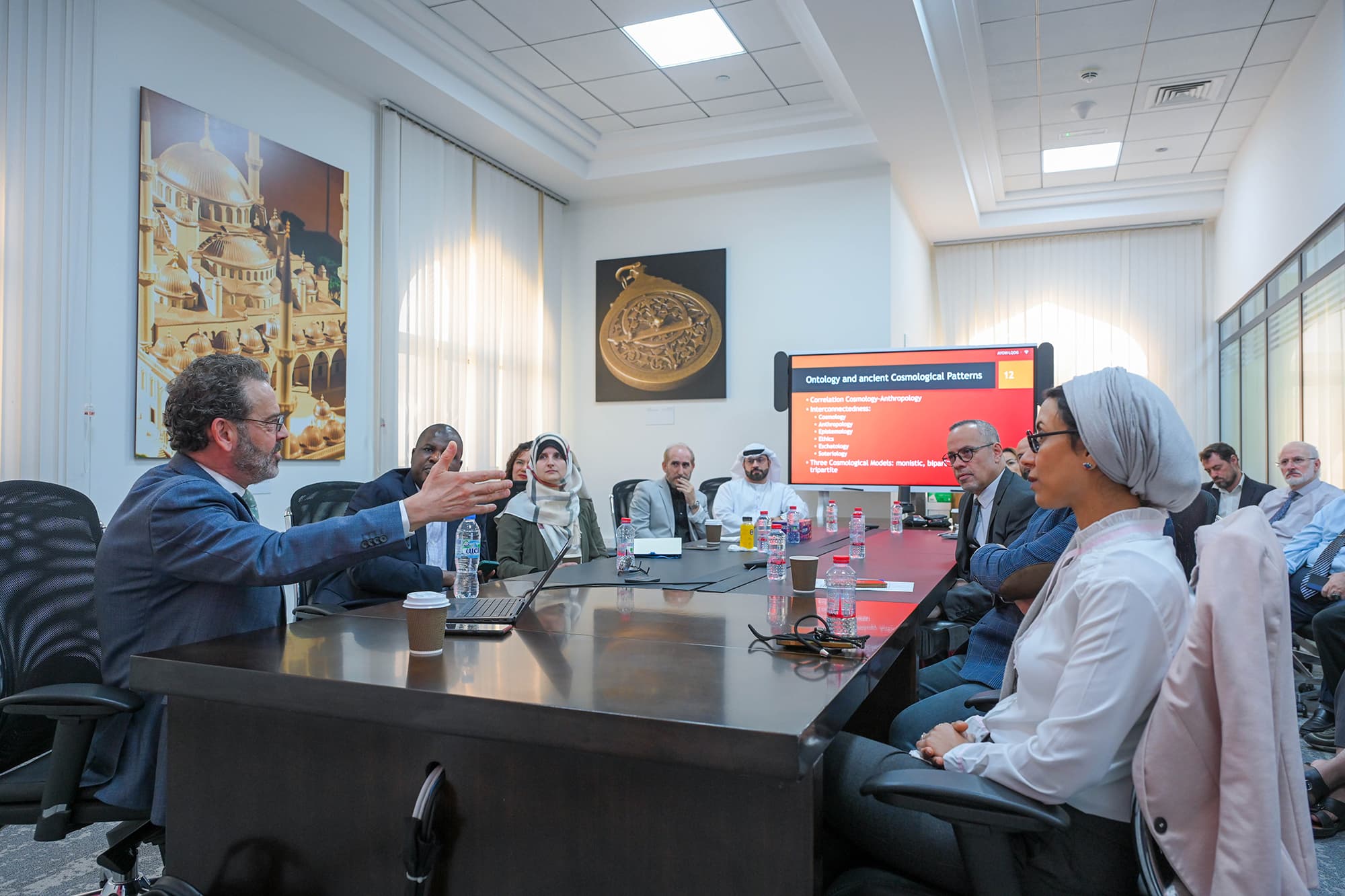
The Sharjah International Foundation for the History of Arab and Muslim Sciences (SIFHAMS) hosted Prof. Lautaro Roig Lanzilotta from the University of Groningen in the Netherlands who delivered a talk titled “Rethinking East–West Cultural Exchanges: Knowledge Transfer and Knowledge Migration in Ancient Cosmology” to a packed audience of researchers, academics, students and enthusiasts drawn to the sweeping history of scientific thought.
Prof. Lanzilotta took aim at the traditional model portraying science as a linear handoff from ancient Greece to the Islamic world and then medieval Europe, a narrative that presumes a stark cultural rupture between East and West. In its place, he advanced the concept of "knowledge migration", positing a continuous shared intellectual space where Greco-Roman, Islamic and Christian traditions intertwined within a unified philosophical discourse. Knowledge, he argued, adapted and reshaped itself amid diverse cultural, religious and institutional contexts. Ancient cosmology served as his vivid case study. Cosmological models did not simply travel unchanged, but underwent constant remoulding as they crossed intellectual frontiers, underscoring the fluid, interconnected nature of scientific thought through time. The lecture traced evolving cosmic visions from Greek philosophy through Islamic scholarship to European interpretations, spotlighting the pivotal roles of translation, reinterpretation and cultural interplay in forging humanity's collective knowledge.
Commenting on the talk, Prof. Mesut Idriz, SIFHAMS director, hailed the event as part of the foundation's drive to foster civilisational dialogue and epistemic openness. It offered students and researchers a chance to engage with cutting-edge studies on science history and intercultural dynamics, while cementing the Arab-Islamic civilisation's profound influence on global scientific thinking.
Lively debate followed, with attendees endorsing a fresh reading of knowledge history that transcends old binaries and embraces it as the fruit of cumulative, cross-cultural exchange across eras.
Share
Quick Links
Activity Highlights