
Global
SAASST Engages Public in Spectacular Total Lunar Eclipse Observation
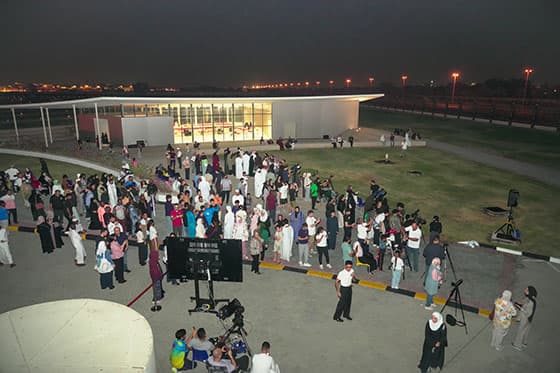
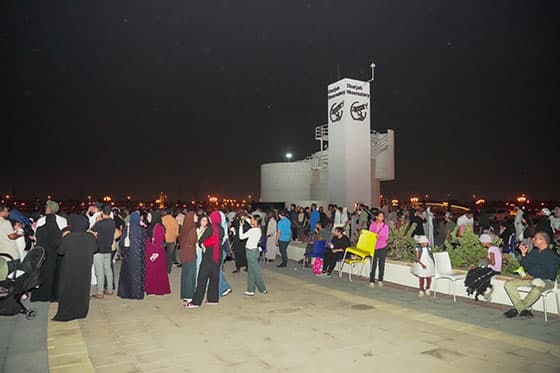
The Sharjah Academy for Astronomy, Space Sciences and Technology, part of the University of Sharjah, hosted a special astronomical event to observe a total lunar eclipse on Sunday, September 7. This rare celestial phenomenon occurs when the Earth aligns nearly perfectly between the Sun and the Moon, casting a complete shadow over the lunar surface. The eclipse was visible across the United Arab Emirates and in parts of the world, drawing a wide audience of researchers, students, and space enthusiasts.
The academy aimed to provide an interactive scientific experience that raises public awareness of significant astronomical events and highlights the UAE’s achievements in the field. Visitors had the opportunity to engage with cutting-edge observational tools and technologies at the Sharjah Observatory, offering a hands-on approach to learning about the cosmos.
In the UAE, the lunar eclipse was visible in its entirety, while sources reported that approximately 85% of the world’s population could observe at least part of this rare phenomenon. In Sharjah, the partial eclipse began at 08:27 p.m., reached its peak at 10:11 p.m., and concluded at 12:55 a.m., lasting about 82 minutes.
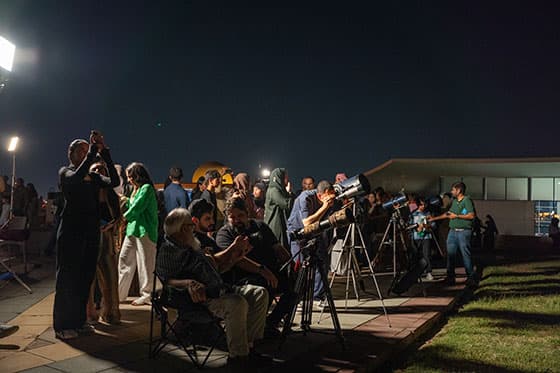
Participants were introduced to methods for tracking the Moon using telescopes and astronomical binoculars. The academy provided a range of high-precision instruments, including a 10-inch Meade Cassegrain telescope, noted for minimizing chromatic and spherical aberrations. Its sturdy equatorial mount, equipped with a motorized tracking system, allowed attendees to observe detailed features on the lunar surface during the eclipse.
The observatory team also offered scientific explanations of the eclipse, describing how the Earth’s shadow passes between the Sun and the Moon, and underscoring the importance of studying such events to understand the movement of celestial bodies from our perspective on Earth.
Professor Hamid M.K. Al Naimiy, Director of the Academy, emphasized that the event represents a key step in promoting scientific literacy. He explained that lunar eclipses occur during a full Moon when the Moon enters the Earth’s shadow. While the phenomenon poses no risk to humans, it holds considerable scientific, cultural, and educational value. He highlighted that this eclipse was the longest since 2018 and reaffirmed the academy’s commitment to organizing regular astronomical events that provide the public with immersive, hands-on learning experiences under the guidance of leading researchers and specialists.
Share
Quick Links
Activity Highlights